









Synthetic CDOs, short for Synthetic Collateralized Debt Obligations, are complex financial instruments that gained prominence in the years leading up to the global financial crisis. They are a type of finance product that allows investors to gain exposure to credit risk without owning the actual underlying assets, such as loans or bonds. Instead of holding physical assets, investors in synthetic CDOs rely on credit default swaps (CDS) to replicate the performance of a reference portfolio of assets.
In a synthetic CDO, the issuer creates different tranches or layers of securities with varying degrees of risk and return. These tranches are designed to appeal to different types of investors, ranging from those seeking higher returns and willing to take on more risk (mezzanine and equity tranches) to those looking for more stable returns and less risk (senior tranches).
The key components of synthetic CDOs include credit default swaps (CDS), reference securities, and a structure that distributes cash flows and losses among the tranches based on the performance of the underlying credit assets. The CDS contracts within the synthetic CDO provide protection against credit events, such as defaults, in the reference portfolio.
Synthetic CDOs played a significant role in the financial crisis of 2008 as their complexity, and the interconnectedness of financial institutions led to substantial losses when credit events occurred in the reference portfolios. These instruments are a prime example of how financial innovation while offering risk management and investment opportunities, can also contribute to systemic risk in the financial markets.
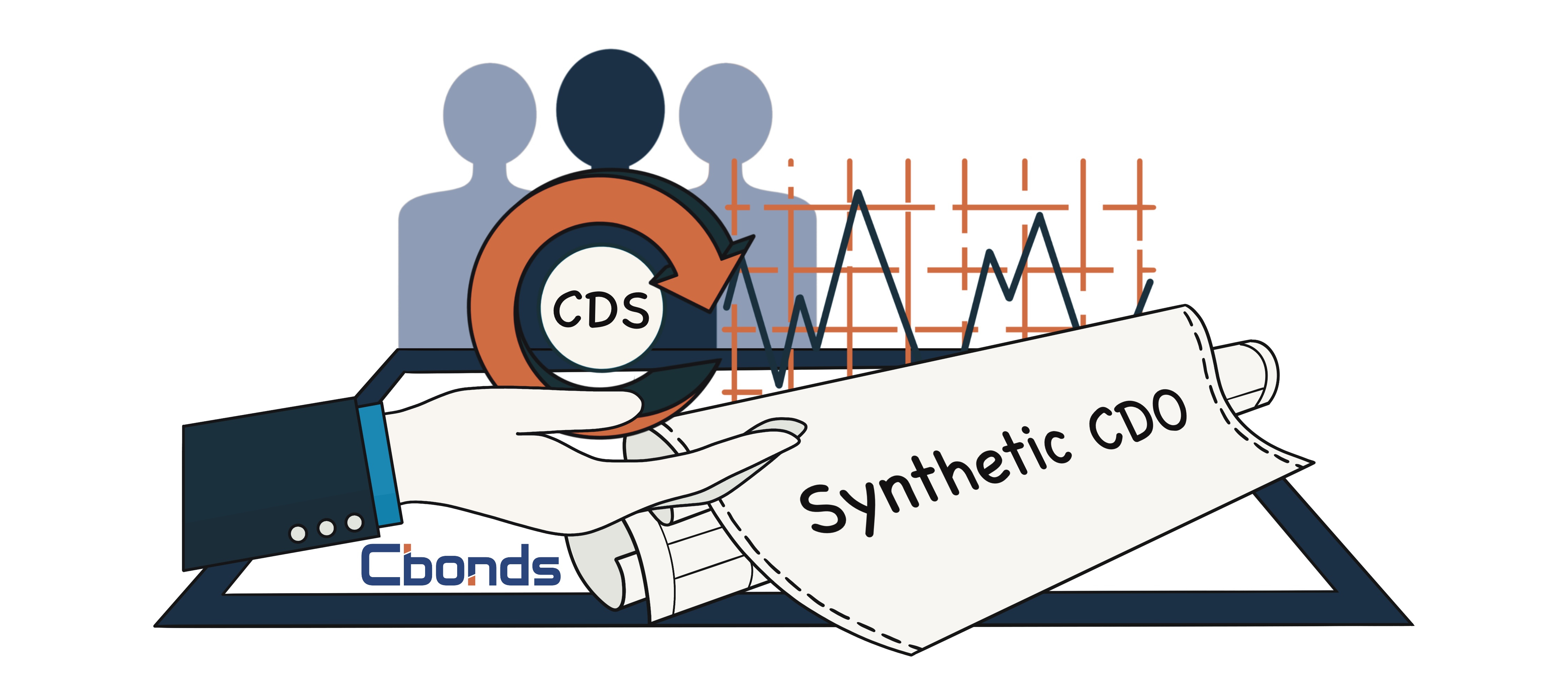
Composition. A synthetic CDO is composed of one or multiple tranches, each representing a portion of a portfolio of credit default swaps (CDS). These CDS may reference either an index of reference securities, such as the CDX or iTraxx indices, or a bespoke portfolio consisting of specific reference obligations or entities tailored for a particular investor.
Risk Distribution. Synthetic CDOs are divided into tranches with varying levels of risk. These tranches offer progressively higher levels of risk to investors, from low-risk senior tranches to higher-risk mezzanine and equity tranches. This risk distribution allows investors to select the level of credit risk they are comfortable assuming.
Seller Position. The seller of the synthetic CDO takes the "long" position, essentially betting that the referenced securities within the CDS portfolio will perform as expected. They receive premiums for the component CDS contracts.
Buyer Position. Conversely, buyers of the component CDS take the "short" position. They pay premiums for the CDS contracts and bet that the referenced securities will default. If defaults occur, the buyer receives significant payouts from the seller, compensating for the losses incurred due to defaults.
Cash Flow Analogous to Regular CDOs. The term "synthetic CDO" is derived from the cash flows generated by the premiums from the component CDS contracts. These cash flows are analogous to the cash flows from mortgage or other obligations within a regular CDO. In essence, taking a long position in a synthetic CDO is akin to taking a long position in a typical CDO, where investors receive regular interest payments on the underlying securities.
Losses in Default. In the unfortunate default event, synthetic CDO and traditional CDO investors experience significant losses.
Synthetic CDOs have evolved significantly over the years, with notable shifts in their role and perception within the financial and credit markets. Here’s a comparison of synthetic CDOs in the past and their present resurgence, incorporating the provided information and terms:
Origins in the Late 1990s. Synthetic CDOs were first introduced in the late 1990s. They emerged as a solution for large holders of commercial loans to protect their bank balance sheets. This innovative approach allowed them to manage risk without selling the loans, a move that could potentially harm client relationships.
Popularity and Customization. Over time, synthetic CDOs gained popularity because of several key factors. They tended to have shorter life spans compared to cash flow CDOs, and there was no extended ramp-up period for earnings on the investment. Moreover, synthetic CDOs were highly customizable, allowing underwriters and investors to tailor them to their desired degree.
Criticism Amid the Subprime Crisis. Synthetic CDOs faced significant criticism due to their role in the subprime mortgage crisis, which ultimately triggered the Great Recession. Investors were exposed to subprime mortgage bonds through synthetic CDOs and credit default swaps. However, many investors were unaware of the high risks associated with the underlying assets. As homeowners defaulted on their mortgages, credit ratings agencies downgraded CDOs, leading investment firms to notify investors that they might not recover their investments.
Resurgence Amidst Demand. Despite their checkered past and association with the subprime crisis, synthetic CDOs are currently experiencing a resurgence. Investors seeking high yields are once again turning to these investments.
Industry Response. Recognizing the renewed interest in synthetic CDOs, large banks and investment firms are responding by hiring credit traders who specialize in this area. This reflects the financial industry’s readiness to meet the demand for these complex financial products.
A synthetic CDO, often regarded as a modern innovation in structured finance, operates in a unique manner, offering the potential for remarkably high yields to investors. Unlike traditional CDOs, which typically invest in conventional debt instruments like bonds, mortgages, and loans, synthetic CDOs derive their income from non-cash credit derivatives, prominently including credit default swaps (CDS), options, and various other contractual agreements.
In the synthetic CDO framework, the seller assumes a long position, expressing the belief that the underlying assets will perform as anticipated. Conversely, the investor adopts a short position, anticipating the same risk that the underlying assets will default, resulting in a payout.
One distinct feature of synthetic CDOs is the potential for investors to be exposed to liabilities exceeding their initial investments if multiple credit events occur within the reference portfolio. In this context, all tranches within the synthetic CDO structure receive periodic payments based on the cash flows generated from the underlying credit risk and default swaps.
It’s essential to note that the payoff dynamics of synthetic CDOs are primarily influenced by credit events associated with risky investments made with CDS contracts. If a credit event transpires within the fixed-income portfolio, the synthetic CDO, along with its investors, assumes responsibility for the incurred losses, starting from the lowest-rated tranches and progressing upward.
This intricate interplay of long and short positions, combined with the reliance on credit default swaps and other derivatives, distinguishes synthetic CDOs from their traditional counterparts and underscores their complexity within the realm of structured finance.
The creation of a synthetic CDO involves a distinct process within the realm of structured finance. In technical terms, a synthetic CDO represents a form of collateralized debt obligation (CDO). However, what sets it apart is how it acquires underlying credit exposures, which are taken using a credit default swap (CDS) rather than the traditional approach of purchasing assets like bonds.
Here’s a breakdown of the steps involved in creating a synthetic CDO:
Selection of Reference Portfolio. The process typically begins with selecting a reference portfolio, which can vary in composition. This portfolio might consist of credit default swaps (CDS) on various reference entities, such as corporate bonds, mortgages, or other forms of debt securities. The choice of reference entities and their credit risk characteristics is critical to structuring the synthetic CDO.
Tranching. Once the reference portfolio is established, the synthetic CDO is divided into different tranches or layers, each with varying degrees of risk and return. These tranches are designed to cater to different investor preferences, with senior tranches offering lower risk and lower returns. In comparison, mezzanine and equity tranches provide higher potential returns but come with higher risk.
Issuer and Investor Roles. The synthetic CDO has two primary roles— the issuer and the investors. The issuer, often an investment bank or financial institution, creates and structures the synthetic CDO. They take the long position on the CDO, effectively betting that the referenced securities within the CDS portfolio will perform as expected. On the other hand, investors take the short position, believing that the referenced securities will default.
Cash Flow Mechanics. The synthetic CDO generates cash flows through the premiums paid for the component credit default swaps. These premium payments, which are analogous to regular interest payments on assets within a traditional CDO, constitute the income stream for investors in the synthetic CDO.
Risk Management. The synthetic CDO market involves careful risk management. The issuer may use various strategies to mitigate risk, such as diversifying the reference portfolio or using additional financial products like options to protect against credit events.
Monitoring and Management. Throughout the life of the synthetic CDO, the issuer and investors closely monitor the performance of the reference portfolio and assess credit events. In the event of defaults or credit events, the cash flows are distributed among the tranches according to their risk characteristics.
Rating Agencies. Rating agencies play a crucial role in assessing the credit quality of synthetic CDO tranches and assigning credit ratings based on their risk profiles. These ratings influence investor decisions and the pricing of the tranches.
Underlying Assets.
CDO (Collateralized Debt Obligation). Traditional CDOs have conventional fixed-income assets as their underlying assets. These assets typically include loans, mortgages, bonds, and other forms of debt securities. The value and performance of the CDO are tied to the cash flows generated by these physical assets.
Synthetic CDO (Synthetic Collateralized Debt Obligation). In contrast, synthetic CDOs employ non-cash assets as their underlying assets. These non-cash assets primarily consist of financial derivatives, such as credit default swaps (CDS), options, and various contractual agreements. The performance and returns of synthetic CDOs are based on the outcomes of these derivative contracts rather than the cash flows from traditional fixed-income assets.
Creation of Exposure.
CDO. Traditional CDOs create exposure to credit risk by purchasing and holding a portfolio of physical debt instruments. Investors in traditional CDOs have direct ownership of these assets.
Synthetic CDO. Synthetic CDOs create credit exposure through the use of financial derivatives, especially credit default swaps (CDS). Investors in synthetic CDOs do not own the underlying assets but instead hold derivative contracts that replicate the credit risk associated with those assets.
Risk and Return Profiles.
CDO. The performance of the physical assets in the portfolio influences traditional CDOs’ risk and return profiles. Investors receive cash flows from these assets’ interest and principal payments. The risk varies based on the credit quality of the underlying assets.
Synthetic CDO. Synthetic CDOs offer a different risk and return profile. They generate returns from the premiums paid on the derivative contracts (e.g., CDS) within the reference portfolio. The risk in synthetic CDOs is linked to the creditworthiness of the entities referenced in the derivative contracts.
Complexity.
CDO. Traditional CDOs are relatively straightforward in structure as they involve holding and managing a portfolio of physical assets. Their performance is tied to the real-world performance of these assets.
Synthetic CDO. Synthetic CDOs are more complex due to their reliance on financial derivatives. They involve multiple layers of contractual agreements and the interplay of long and short positions. Their performance is based on the outcomes of derivative contracts and can be influenced by market factors and credit events.
Tranches Defined. Tranches, also known as slices or segments, represent divisions of credit risk within a synthetic CDO. These divisions are categorized based on risk levels, and the three primary tranches typically used in CDOs are senior, mezzanine, and equity.
Risk and Return Profiles.
Senior Tranche. The senior tranche comprises securities with high credit ratings and is characterized by lower risk. Consequently, it offers relatively lower returns. This tranche is considered the safest within the synthetic CDO structure.
Mezzanine Tranche. Regarding risk and return, the mezzanine tranches fall between the senior and equity tranches. It includes derivatives with moderate credit ratings, offering moderate returns. Investors in the mezzanine tranche accept a higher risk level than the senior tranche.
Equity Tranche. The equity-level tranche carries the highest degree of risk among the three. It consists of derivatives with lower credit ratings, translating into higher potential returns. However, the equity tranche is the first to absorb any potential losses in the synthetic CDO, making it the riskiest but potentially most rewarding for investors.
Matching Risk Appetite. Tranches are instrumental in making synthetic CDOs appealing to various investors with varying risk appetites. Investors can select a tranche that aligns with their desired level of risk and return. For instance, an investor seeking lower risk might opt for the senior tranche, which offers stability and safety.
Customization. Synthetic CDOs can be customized to cater to specific investor preferences by creating tranches that mirror the risk profile of the desired investment. For example, a synthetic CDO may be structured to include U.S. Treasury bonds and corporate bonds rated AAA, a configuration suitable for investors seeking a high-rated and low-risk investment. Such a synthetic CDO would typically consist of a single tranche, often the senior tranche, aligning with the investor’s risk tolerance and return expectations.
The use of synthetic CDOs has faced significant criticism, particularly in the context of the subprime mortgage crisis. Here’s an overview of the criticisms and concerns associated with synthetic CDOs:
Amplifying the Subprime Mortgage Crisis. Synthetic CDOs have been strongly criticized for exacerbating the subprime mortgage crisis. Journalists Bethany McLean and Joe Nocera characterized synthetic CDOs as turning the "keg of dynamite" that was subprime loans "into the financial equivalent of a nuclear bomb." This critique underscores synthetic CDOs’ role in magnifying the crisis’s impact.
Hidden Complexity. Critics argue that the growth of synthetic CDOs introduced complexity that many market participants did not understand. This complexity was seen as a contributing factor to the severity of the crisis.
Calls for Banning. Prominent figures in economics and finance, such as economist Paul Krugman and financier George Soros, have called for the banning of synthetic CDOs. They raised concerns about the risks associated with these financial instruments and their potential to destabilize financial markets.
Concerns About Risky Bets. Paul Krugman, in particular, emphasized the need to block the creation of synthetic CDOs. He described them as "cocktails of credit default swaps that let investors take big bets on assets without actually owning them." This detachment from the underlying assets raised concerns about the ability to take highly leveraged and risky positions.
Instruments of Destruction. George Soros labeled credit default swaps (CDS), which are central to synthetic CDOs, as "instruments of destruction" that should be outlawed. This view reflects the belief that the widespread use of CDS contributed to the financial turmoil.
Shift in Investment Banking Culture. Critics have also pointed to a shift in the culture of investment banks. Rather than focusing on the productive allocation of savings, there was a shift towards maximizing profits through proprietary trading and facilitating speculative transactions. This shift in mindset was seen as a driver of risky financial innovations, including synthetic CDOs.
Volcker Rule Advocacy. Former Federal Reserve Chairman Paul Volcker advocated for the separation of proprietary trading and financial intermediation in banks. The Volcker Rule would restrict banks from trading on their own accounts. This proposal aimed to prevent banks from engaging in proprietary trading activities, including creating and trading synthetic CDOs.


Everything you need for fixed income research and monitoring.






 Bond Screener
 Hide
Hide 