









Musharaka, or Musharakah, is an Islamic financial instrument, representing a joint venture or partnership structure. In this Islamic finance model, two or more parties come together to invest capital in a business or project. The capital invested by all the partners is used to fund the venture, adhering to the principles of Islamic banking.
In Musharakah, profits and losses are shared among all the partners based on a pre-agreed ratio, emphasizing the concept of equal partnership. This stands in stark contrast to conventional interest-based lending, as Islamic law strictly prohibits profiting from interest. Instead, Musharakah allows the financiers to gain returns in the form of a portion of the actual profits generated by the enterprise.
Musharakah is a key component of Islamic finance, providing an alternative and Sharia-compliant method for financing projects and business operations. The partnership structure fosters cooperation and mutual benefit, reflecting the core values of Islamic economics.
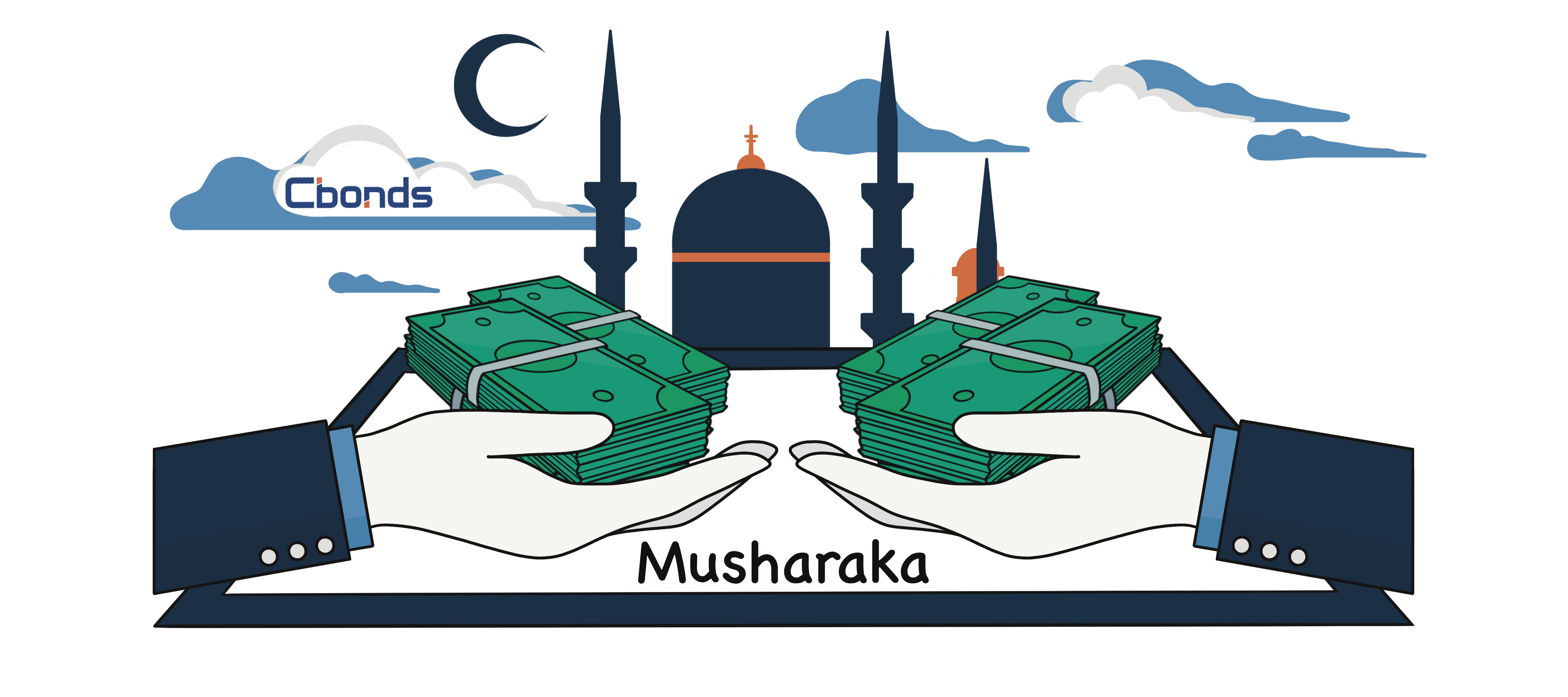
Consider a scenario where individual A aspires to initiate a business but faces limited funds. In this context, individual B, possessing surplus funds, opts to engage in musharakah with A, establishing a joint venture where both partners contribute capital and consequently share in the profits and losses. This mutually beneficial arrangement eliminates the necessity for A to seek a conventional loan from B.
This versatile financial mechanism finds application in various domains, including the acquisition of property and real estate, provision of credit, investment projects, and financing substantial purchases. In real estate transactions, partners typically approach a bank to assess the property’s value through imputed rent—a sum reflective of what a partner might pay to reside in the property. Profits are then distributed among the partners based on predetermined ratios, considering the assigned value and the respective stakes contributed.
Moreover, Musharakah plays a key role in facilitating credit and investment projects. When financing large purchases, banks often employ floating-rate interest loans tied to the company’s rate of return, effectively utilizing the company’s performance as a benchmark for the lending partner’s profit. This aligns with the principles of Musharakah, where each party contributing capital holds a stake in decision-making, reinforcing a collaborative and equitable approach to business ventures.
Alice and Bob decide to venture into a clothing business together. Each contributes an equal amount of $50,000 as capital to establish the business, resulting in a total capital of $100,000. They agree on a Musharakah partnership, where profits and losses will be shared equally.
In the first year of operations, the business performed well, generating a net profit of $80,000. According to their Musharakah agreement, Alice and Bob distribute the profits equally:
Alice’s share: $40,000 (1/2 of $80,000)
Bob’s share: $40,000 (1/2 of $80,000)
Expressing satisfaction with the business’s success, they decide to reinvest some profits to expand the product range. Both partners contribute their respective shares to the Musharakah pool, increasing the total capital to $120,000 (Alice: $60,000, Bob: $60,000).
Facing challenges in the second year, the net profit decreased to $20,000. As per their Musharakah agreement, profits are once again distributed equally:
Alice’s share: $10,000 (1/2 of $20,000)
Bob’s share: $10,000 (1/2 of $20,000)
Despite the challenges, both partners decide to continue the partnership for another year, reinforcing their commitment to equal distribution of profits and losses. This example showcases a straightforward Musharakah partnership, highlighting the equal contribution of capital, shared decision-making, and the cooperative sharing of both successes and challenges in the business.
Shirkah Al-Milk or Partnership in Joint Ownership. This type involves shared ownership of a property or asset among more than two persons. It emphasizes joint ownership and collaboration in managing the associated assets.
Shirkah Al-Aqd or Mutual Partnership. This form of Musharakah arises from a mutual contract, leading to a partnership between more than two persons, primarily for business-related financing. The Contractual Partnership is further subdivided into three types: Shirkat-ul-Amwal or Contractual Partnership, Shirkat-ul-A’mal or Liability Partnership, and Shirkat-ul-Wujooh or Vocational Partnership.
Permanent Musharakah. In Permanent Musharakah, Islamic banks participate in a project’s equity, earning a share of the actual profit on a pro-rata basis. This type of Musharakah is suitable for long-term financing of projects with extended gestation periods and continues until the partners decide otherwise.
Diminishing Musharakah. While similar to Permanent Musharakah, in Diminishing Musharakah, the Islamic bank’s equity in a project gradually decreases until ownership of the asset transfers to the partner owners. The investor bank receives dividends over its equity, progressively reducing to zero as the investor acquires portions of the asset. This structure renders the bank a non-partner in the project over time.
Utilization of Excess Liquidity. Efficient use of excess liquidity held by Islamic bank, preventing underutilization.
Higher Returns for Islamic Banks. Participating in joint ventures leads to higher returns for Islamic banks compared to traditional methods.
Equitable Risk Distribution. Risks are evenly distributed among partners, fostering a collaborative risk-sharing approach.
Equal Sharing of Losses. Every partner shares the loss equally, promoting fairness and collective responsibility.
Inclusive Benefit for Account Holders. Benefits not only the banks but also account holders, especially those with limited financial resources.
Prone to Mismanagement. Arrangements are prone to mismanagement by partners, leading to potential losses.
Constant Supervision and Increased Financing Costs. Requires constant supervision, leading to increased financing costs.
Uncertain Profitability. Profits cannot be guaranteed, potentially deterring risk-averse investors.
Criticism for Being Ancient. Criticized for being perceived as ancient, hindering acceptance in modern financial practices.
Nature of Transaction
Musharakah. Involves a partnership for joint ventures or enterprises, with profits and losses shared among partners.
Musawamah. Represents a general kind of sale where the price is stipulated directly between the buyer and seller, without reference to the seller’s cost.
Investment Structure
Musharakah. Requires contributions from all partners or shareholders for the joint enterprise.
Musawamah. Involves a buyer-seller relationship without the need for a joint investment structure.
Profit and Loss Sharing
Musharakah. Profits and losses are shared among partners according to agreed-upon proportions.
Musawamah. The transaction does not involve profit or loss sharing; it is a straightforward sale.
Mudarib’s Role
Musharakah. If the Mudarib (manager) contributes capital, they are entitled to a share of the profit in proportion to their capital and their share as Mudarib.
Musawamah. Does not involve the concept of a Mudarib or profit-sharing based on managerial contributions.
Pricing Formula
Musharakah. Does not specify a pricing formula, as it is primarily focused on profit and loss sharing in joint ventures.
Musawamah. Differs in terms of pricing, as the seller is not obliged to disclose their cost. The price is directly negotiated between buyer and seller.
Nature of Transaction
Musharakah. Involves a relationship established under a contract for sharing profits and losses from a joint enterprise or venture.
Ijarah. Entails leasing, where the corpus of the leased commodity remains in the ownership of the lessor, and only its usufruct is transferred to the lessee.
Ownership and Usage
Musharakah. Partners jointly own all assets in proportion to their capital and actively participate in the enterprise.
Ijarah. The lessor retains ownership of the leased assets throughout the lease term, and the lessee only has the right to use the assets.
Risk and Responsibility
Musharakah. Profits and losses are shared among partners based on their agreed-upon proportions. All partners share the risks and rewards.
Ijarah. Lessor bears all risks and rewards pertaining to ownership during the lease term. Lessee is responsible for damage or loss due to fault or negligence.
Insurance
Musharakah. Insurance of the jointly owned assets is typically a joint responsibility of the partners.
Ijarah. The lessor is responsible for insuring the leased asset, and the lessor bears the cost of such insurance.
Termination and Promise to Purchase
Musharakah. Can be terminated with mutual consent. Unilateral promises to buy/sell assets can be made at the lease’s expiry, but the lease is not conditional upon such sale.
Ijarah. Can be terminated with mutual consent. Unilateral promises to buy/sell assets can be made at the lease’s expiry, but the lease is not conditional upon such sale.
Nature of Transaction.
Musharakah. Represents a joint venture between partners.
Murabaha. Involves a loan from the bank to the customer.
Investment Duration.
Musharakah. Generally considered a long-term investment.
Murabaha. Typically a short-term investment.
Common Usage.
Musharakah. Often employed by venture capitalists.
Murabaha. Predominantly used by banks.
Role of Parties.
Musharakah. Both parties are equal partners in the venture.
Murabaha. The bank serves as the lender, and the customer is the borrower.

Everything you need for fixed income research and monitoring.






 Bond Screener
 Hide
Hide 