









Explore the most comprehensive database
1 000 000
bonds
80 234
stocks
167 970
ETF & Funds
70 000
indices
Track your portfolio in the most efficient way


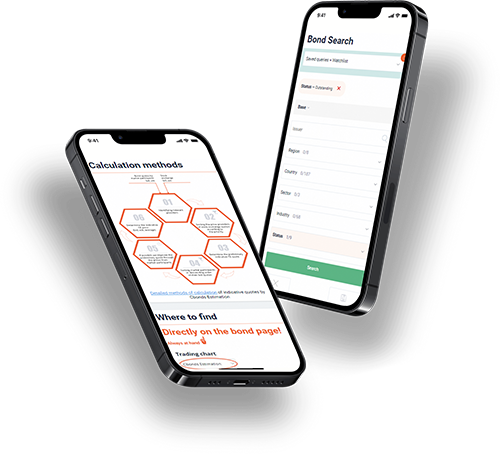
full data on over 900 000 bonds, 80 000 stocks, 116 000 ETF & Funds; powerful bond screener; over 350 pricing sources among stock exchanges & OTC market; ratings & financial reports; user-friendly interface; available anywhere via Website, Excel Add-in and Mobile app.
Register





 Bond Screener
EMEA Daily Update
Hungary (=)
- PM Orban announced following an EU Council summit that the Hungarian govt was rejecting two of five country-specific policy recommendations that the EC had made to Hungary (country-specific recommendations are made when a country possesses macroeconomic imbalances requiring decisive policy action). These involve 1) the public works programme of the govt which has added significantly to economic growth in recent quarters and is slated to be expanded by 26% in 2016; the EC wants funding for this programme to be reduced; and 2) further fiscal consolidation amounting to 0.5%-0.6% of GDP deficit reduction over the next two years. The govt disagrees about the need to reduce the work programme or to make further fiscal cutback -- the govt has outright rejected these two recommendations -- and is also reportedly unhappy about a third recommedation (which is to cut down on sector taxes). Orban is confident of meeting 1.7% of GDP fiscal deficit by 2017 without any further measures. And, Hungary is out of excessive deficit procedure now, hence these recommendations are not binding.
Poland (=)
- The zloty along with the forint have been hit hard over the past week as developments surrounding Greece have escalated: in our view, this reflects the hi-beta nature of the currencies, which manifests during 'contagion' events. Both Polish and Hungarian govts have come out to emphasise that the economies are well insulated and that direct exposure to Greece is minimal. This is borne out by our analysis too: on both trade and cross-border banking assets, Poland and Hungary are minimally exposed to Greece. Within CEE, 1) Turkey and Romania are among the major CEE countries which have larger banking sector exposure to Greece, 2) While Bulgaria and Macedonia have both trade and banking sector exposures.
- In other words, the impact on PLN and HUF is not particularly fundamental, and is best viewed as a reflection of general risk off around EM. Polish PM Kopacz strongly reiterated yesterday that there is little economic exposure to Greece to worry about, and that both the FinMin and NBP are standing by to intervene in the FX market to limit contagion. Deputy FinMin Radziwill, however, added that the moves in Polish bonds or zloty so far do not warrant such intervention response, and that Poland plans even to go ahead with its bond auction on 9 Jul.
Turkey (=)
- The Turkish PMI and confidence indicators appeared to stabilise in May -- but, we find that official composite sentiment indices fell again in Jun (by 4.5pts); the Jun decline was driven by manufacturing and service sector sentiment, with the breakdown suggesting a loss of confidence about the near-term demand outlook. This is understandable given the pause in order-flow triggered by uncertainty about what form govt will take next month. No matter the cause, what is crucial is that the combination of political uncertainty and auto sector strikes has effectively reversed whatever mild recovery momentum that had begun to emerge by mid-Q2; and this is even before Fed hikes have become a factor -- the economic cycle will require a fresh kick-start again once the policy environment has stabilised.