









A death spiral refers to a convertible bond or debt instrument that not only provides interest payments but also offers the option to convert into a fixed number of company shares. This financial instrument represents a hybrid security, blending characteristics of both bonds and stocks.
Death spiral financing arises from poorly designed convertible financing arrangements typically employed by small-cap companies in the market. This type of financing can trigger a significant decline in the company’s stock value, potentially culminating in the company’s eventual collapse. Many small businesses depend on issuing convertible debt to attract substantial private investors (referenced as private investment in public equity or PIPE) as a means to secure funds for their operations and expansion.
The conversion of a death spiral bond results in a predetermined dollar value. However, the company responsible for issuing this type of debt doesn’t settle with cash payments to the new bondholders; instead, it compensates them with fresh shares of its own stock.
Consequently, the death spiral mechanism causes an ever-increasing number of company shares to enter the market. This proliferation of shares leads to a dilution of the ownership stake held by existing stockholders, inevitably precipitating a significant decline in the share price.
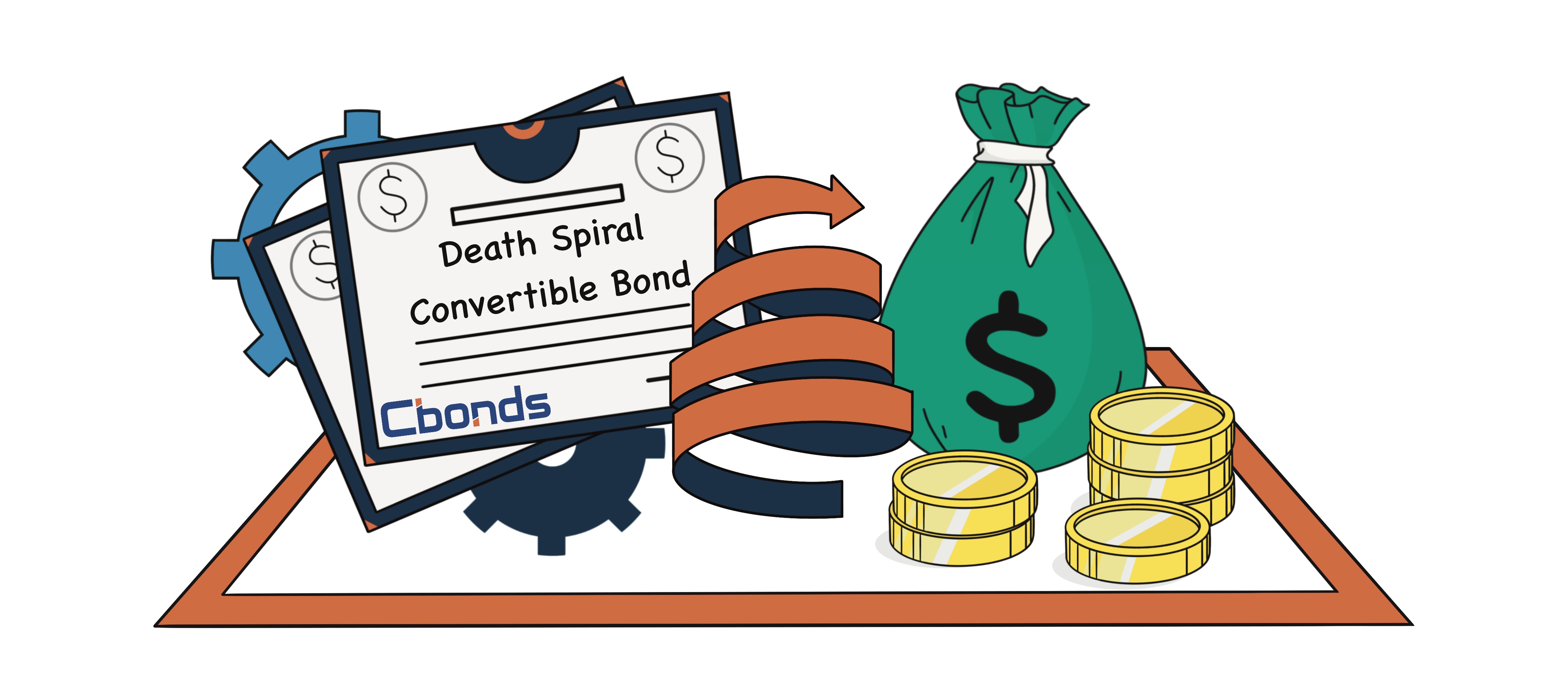
In the realm of convertible securities, such as bonds or preferred stock, the conventional approach involves a fixed conversion into a set number of shares. In contrast, death spiral debt operates on a unique principle, converting into a predetermined value disbursed in the form of shares.
When the price of a regular convertible stock experiences significant growth, investors holding these instruments often seize the opportunity to convert their holdings into rapidly appreciating stocks.
However, in the case of fixed-value convertible bonds or shares, a stock price decline serves as an incentive for their owners. This decline means that they can acquire a larger number of shares when performing the conversion. As a result, this process inherently injects more shares into the market, putting downward pressure on prices.
The death spiral effect unfolds as an increasing number of fixed-value convertible instrument holders choose to convert their holdings into common stock, particularly as the value of their holdings continues to decline. This cascade effect exacerbates the market with more shares and exerts further downward pressure on prices.
Companies sometimes resort to issuing this type of debt when they find themselves in dire need of cash. In situations where a company is seeking death spiral financing, it often signifies that they have exhausted all other avenues to secure funds necessary for their survival.
It’s important to emphasize that death spirals typically enable buyers to convert their bonds or stock into common shares at a fixed value, not a fixed ratio. For instance, a bond with a face value of $1,000 may offer a conversion amount of $1,500. In practical terms, this means that a bondholder can exchange a $1,000 bond for common shares worth $1,500.
However, the act of conversion results in the creation of more shares, leading to dilution of the share price. This decrease in share value might prompt additional bondholders to convert, as the lower share price means they will receive a larger quantity of shares.
While a conventional convertible bond offers conversion into a set number of shares, it’s crucial to highlight that death spiral debt converts the debt into a predetermined value, ultimately disbursed to bondholders in the form of shares. This distinction often serves as a telltale sign for bankers and lawyers when identifying a death spiral scenario in their financial pipeline.
In simple terms, as this type of bond undergoes more conversions, it results in the creation of additional shares, subsequently driving down the share price.
Convertible bonds hold appeal for investors who anticipate a surge in a company’s performance and expect its stock to appreciate. When a company’s stock price experiences a significant increase, investors holding conventional convertible bonds are likely to convert them into shares to take advantage of favorable pricing opportunities.
However, in the context of a death spiral, a decline in the stock price similarly motivates owners of fixed-value convertible bonds. These bondholders stand to receive more shares of stock upon conversion. By its very nature, the introduction of more shares into the market exerts downward pressure on prices.
Death spirals materialize as an increasing number of fixed-value convertible bondholders opt to convert their bonds into stocks, especially as the bond values continue to decline. Companies that typically issue this type of bond are often in dire need of cash to sustain their operations.
Compounding the challenges of the death spiral, investors who hold the convertible debt engage in short selling of the issuer’s common stock, leading to a swift decline in the stock price. Simultaneously, the death spiral bondholder converts a portion of their convertible debt into common shares, effectively closing out their short position.
Subsequently, the debt holder continues to participate in short selling, joining other shareholders who are also selling due to the rapidly falling price. This collective action further erodes the share price, rendering it unattractive to potential new investors and potential sources of financing, as reported by Capital.com.


Everything you need for fixed income research and monitoring.






 Bond Screener
 Hide
Hide 